
Giving gifts in Islam is a Sunnah of the Prophet Muhammad ﷺ that builds love between people. He said, “Give gifts to one another, and you will love one another,” and he accepted gifts and gave gifts in return. A gift in Islam is called hadiyyah. It differs from Sadaqah, which is given to people in need for the sake of Allah’s reward, but both are acts of kindness that Islam warmly encourages.
This guide from Human Concern International UK explains what the Quran and Sunnah teach about gifts, the etiquette of giving and receiving them, the gifts Islam does not allow, and how a gift can also become Sadaqah Jariyah, an act of charity in someone’s name that keeps earning reward.
Islam teaches that gifts strengthen love, remove resentment and honour the people we care about.
The Prophet ﷺ said: “Give gifts to one another, and you will love one another.” (Al-Adab al-Mufrad by Imam al-Bukhari, graded hasan by al-Albani)
This short hadith gives the purpose of every gift in Islam. A gift is not about price. It is about the bond it builds between two hearts.
Aisha (may Allah be pleased with her) said that the Messenger of Allah ﷺ used to accept gifts and would give something in return (Sahih al-Bukhari). He did not only receive. He made sure kindness flowed both ways.
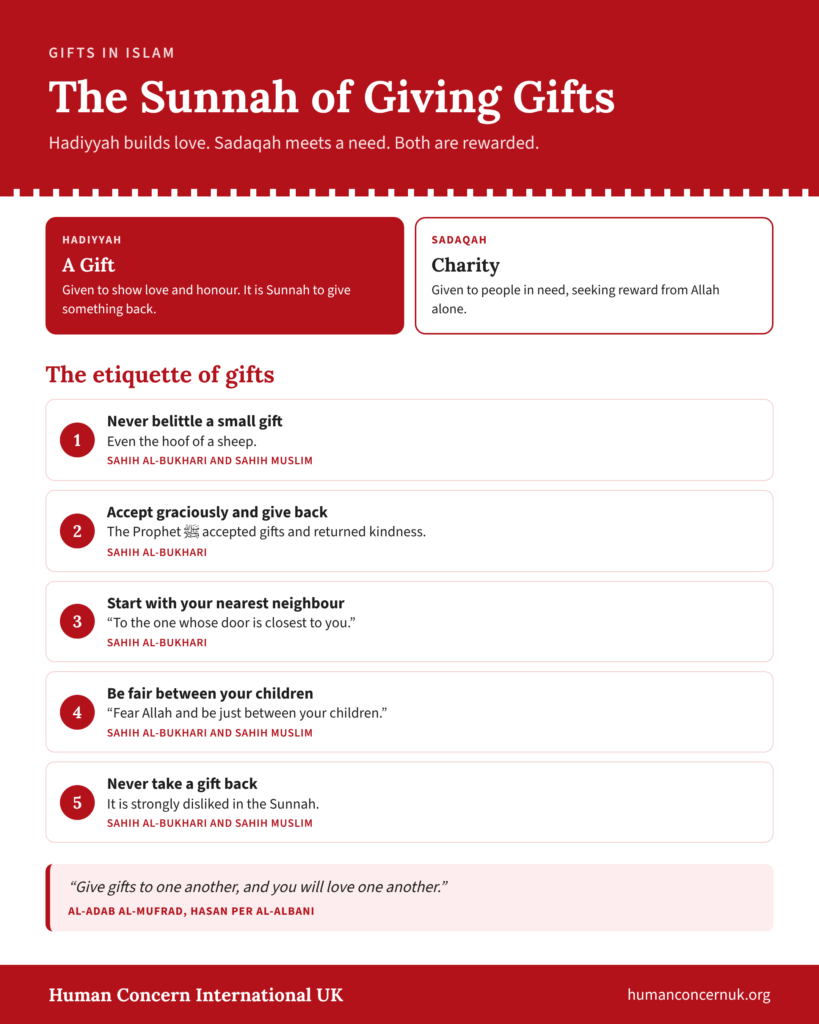
A gift (hadiyyah) is given to build love and honour a person, while Sadaqah is given to someone in need to seek reward from Allah.
| Gift (Hadiyyah) | Sadaqah | |
|---|---|---|
| Purpose | To show love and honour | To seek Allah’s reward and meet a need |
| Recipient | Anyone: family, friends, neighbours, colleagues | Usually people in need |
| Return | It is Sunnah to return a gift | No return is expected |
| The Prophet ﷺ | Accepted gifts | Did not take Sadaqah for himself or his family |
When food was brought to the Prophet ﷺ, he would ask whether it was a gift or Sadaqah. If it was Sadaqah, he told his companions to eat and did not eat himself. If it was a gift, he ate with them (Sahih al-Bukhari). Sadaqah was not permitted for him or his family (Sahih Muslim).
Both forms of giving are good. Our guide to what is Sadaqah explains charity in more detail.
The etiquette of gifts in Islam is to give sincerely, accept graciously, never belittle a gift, and return kindness where you can.
The Prophet ﷺ said: “O Muslim women, let no neighbour belittle a gift to her neighbour, even if it is the hoof of a sheep.” (Sahih al-Bukhari and Sahih Muslim). A small gift given with love is better than an expensive one given with pride.
The Prophet ﷺ never turned down perfume when it was offered as a gift (Sahih al-Bukhari). Accepting a gift warmly honours the giver.
Following the Sunnah, return a gift with a gift, a kind word or a dua. Saying “JazakAllahu khayran”, may Allah reward you with good, is itself a way of thanking the giver.
Aisha asked the Prophet ﷺ which of her two neighbours she should give a gift to. He said: “To the one whose door is closest to you.” (Sahih al-Bukhari)
When a companion gave a gift to one of his sons only, the Prophet ﷺ asked if he had given the same to all his children. When he said no, the Prophet ﷺ said: “Fear Allah and be just between your children.” (Sahih al-Bukhari and Sahih Muslim)
Gifts are not allowed in Islam when they act as bribes, are taken back after being given, or are made of things that are themselves forbidden.
Yes. Umar ibn al-Khattab (may Allah be pleased with him) gave a fine garment, which the Prophet ﷺ had given him, to his brother in Makkah who was not yet Muslim (Sahih al-Bukhari). Gifts to neighbours, colleagues and friends of other faiths are a beautiful way to show the character of Islam in British towns and workplaces.
Muslims give gifts at Eid, weddings, the birth of a child, after Umrah or Hajj, and simply to show love at any time of year.
Yes. One of the most meaningful gifts you can give is charity in someone’s name, such as a water well, a child’s education or a food pack. It honours the person you love and brings ongoing reward.
The companions understood this. Sa’d ibn Ubadah (may Allah be pleased with him) dug a well and dedicated it to his late mother after the Prophet ﷺ told him the best charity was water (Sunan Abi Dawud, graded hasan by al-Albani). A charity gift can mark a birthday, a wedding, a new baby or the memory of someone who has passed away. Learn more in what is Sadaqah Jariyah and our guide to Sadaqah Jariyah for the deceased.
If you want ideas for everyday giving alongside your gifts, read our guide to the best ways to give Sadaqah.
Human Concern International UK is a registered charity in England and Wales (charity number 1206222), based in Manchester. We share the name and mission of Human Concern International, which has delivered relief and development since 1980. We provide clean water, food, healthcare, education and orphan support through field teams and trusted local partners who verify need.
The best gifts are remembered long after they are opened. A water well or a child’s education given in someone’s name keeps earning reward for them and for you. Give Sadaqah Jariyah today as a gift for someone you love.
Give a little extra