
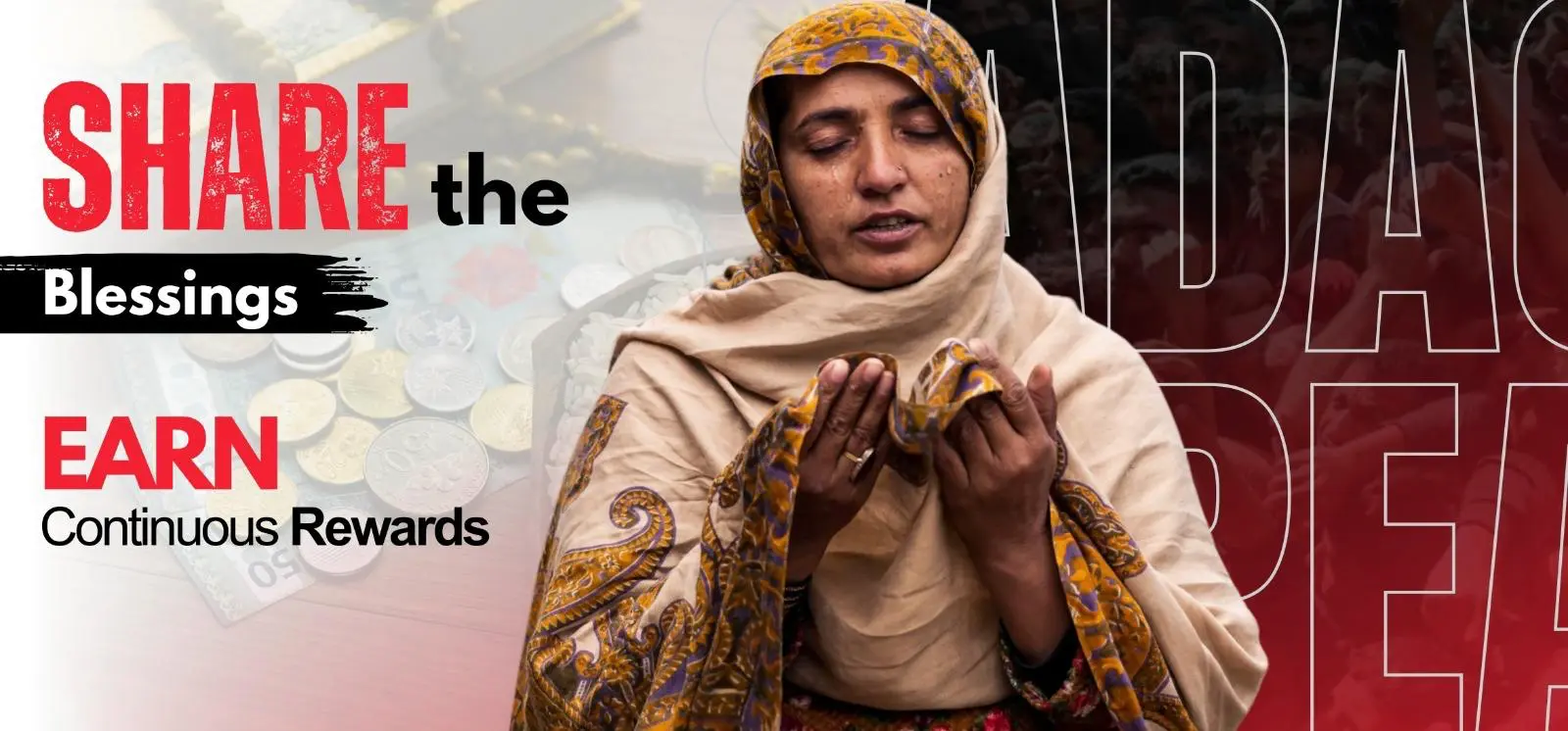
Even a brief experience of hunger opens our hearts to the struggles of others. It reminds us that millions go without food every day, and many also lack clean water, shelter, education, and healthcare. When you give Sadaqah, you respond to that struggle straight away.
Every Sadaqah donation, however small, carries reward and real impact. A single gift can put a hot meal in front of a hungry child, place clean water within reach of a family, or fund urgent medical treatment in a conflict zone. Hardship does not pause, so your response matters in moments like these.
The Prophet (peace be upon him) said the most beloved charity is that which is given consistently. This is why so many supporters choose to give Sadaqah monthly, turning a single act of kindness into steady, ongoing relief.
Sadaqah is a voluntary act of charity in Islam that you can give at any time, in any amount, to help those in need. Unlike Zakat, which is an obligatory annual payment, Sadaqah is given freely from the heart and is never tied to a fixed threshold or date.
Sadaqah charity is one of the most rewarding acts a Muslim can perform. It is not only money. A kind word, a smile, removing harm from a path, or feeding a hungry person are all forms of Sadaqah. When you make a Sadaqah donation online through Human Concern UK, that giving is channelled directly into food, water, healthcare, and emergency aid for the people who need it most.
Giving Sadaqah purifies wealth, draws a believer closer to Allah, and reconnects us to our faith, our humanity, and one another. The Prophet Muhammad (peace be upon him) said:
No. Sadaqah and Sadaqah Jariyah are related but serve different purposes. Sadaqah is immediate support, such as providing food, clean water, or emergency relief. Sadaqah Jariyah is a lasting contribution, such as building a well, supporting education, or funding healthcare, whose benefits continue over time and keep earning reward even after the giver has passed away.
| Sadaqah | Sadaqah Jariyah | |
|---|---|---|
| Meaning | Voluntary charity given now | Ongoing, continuous charity |
| Impact | Immediate relief | Long-lasting benefit |
| Examples | A hot meal, clean water, and medical aid | A water well, a school, a learning fund |
| Reward | Rewarded once given | Continues for years, even after death |
| Best for | Responding to urgent needs today | Leaving a legacy of giving |
Both are powerful. Many donors choose to pay Sadaqah for urgent needs and to add a Sadaqah Jariyah gift for a lasting legacy. You can do both with a single Sadaqah donation to Human Concern UK.
When you donate Sadaqah with Human Concern UK, your generosity is put straight to work where the need is greatest. Your gift can support:
Delivering hot meals and food parcels to families facing hunger.
Funding sustainable water projects in communities without a safe supply.
Responding fast during crises and conflicts in regions such as Gaza, Yemen, Syria, and Pakistan.
Supporting medical treatment and life-saving care for the vulnerable.
Funding learning for children who would otherwise go without.
When we give, we reconnect to our faith, our humanity, and one another. Every meal, every gift, and every act of giving brings relief and hope to someone in need right now.
You should pay Sadaqah online with a charity you can trust completely, because your giving is an amanah and it must reach the people it was intended for. Human Concern UK is a UK-registered Muslim relief charity (Charity Number 1206222) committed to fighting poverty and delivering aid to those in need, both at home and around the world.
When you give Sadaqah online with Human Concern UK, you get:
Giving Sadaqah online removes every barrier between your intention and someone’s relief. There is no need to wait. You can give Sadaqah online today and know your kindness is already on its way to a family who needs it.
Sadaqah is not just about obligation. It is about responding to a quiet call within your heart, the awareness that you have more than you need while others are struggling. This is not about numbers. It is about impact.
Give Sadaqah online today with Human Concern UK and let your compassion reach those who need it most.
Sadaqah is generally divided into two broad categories. The first is immediate charity, such as providing food or clean water to someone in need. The second is an ongoing charity, known as Sadaqah Jariyah, such as building a well, whose benefits continue over time.
No, Sadaqah is not only money. While a financial Sadaqah donation is one of the most common and impactful forms, Sadaqah also includes any act of kindness, such as a smile, a kind word, removing harm from a path, or helping someone in need. The Prophet (peace be upon him) taught that every good deed is a form of charity.
There are no strict rules or minimum amounts for Sadaqah. It is voluntary, can be given at any time, and any amount is accepted and rewarded. The only conditions are that it should be given sincerely for the sake of Allah and, ideally, from lawful (halal) earnings. You can pay Sadaqah online whenever you wish.
The most impactful form of Sadaqah is often Sadaqah Jariyah, because its benefits continue long after the gift is given. A water well, an education fund, or a healthcare project keeps helping people and earning rewards for years. That said, urgent food and emergency relief can be the most impactful Sadaqah in moments of crisis, when help is needed immediately.
Anyone in genuine need can receive Sadaqah, including the poor, orphans, refugees, the sick, and those affected by conflict or disaster. Unlike Zakat, Sadaqah has no fixed categories of recipients, so it can reach a wider range of vulnerable people. When you donate Sadaqah with Human Concern UK, your gift is directed to those facing the greatest hardship.
The best time to give Sadaqah is now, because need does not pause. Sadaqah can be given at any time of year, on any day. Many Muslims give extra Sadaqah during Ramadan and on the blessed days of Dhul Hijjah, when rewards are multiplied, but consistent giving throughout the year is especially beloved.
Yes, Sadaqah is described in authentic teachings as a means of wiping away sins. The Prophet (peace be upon him) said charity extinguishes sin as water extinguishes fire (Tirmidhi). Giving Sadaqah sincerely purifies both wealth and the heart.
The Prophet Muhammad (peace be upon him) emphasised the reward of Sadaqah in many sayings. He taught that “charity does not decrease wealth” (Sahih Muslim) and that relieving a believer’s distress in this world leads to relief on the Day of Resurrection (Sahih Muslim 2699). His example shows that even the smallest act of giving carries great value.
Give a little extra