
The hadith about charity teach that giving never decreases wealth, that even half a date can shield you from the Fire, and that every act of kindness counts as Sadaqah. The Prophet Muhammad ﷺ spoke about charity more than almost any other good deed, and his words show that it purifies wealth, removes sins and brings reward that can continue after death. This guide gathers 20 authentic hadith on charity, each with its source and a short note on what it means for your giving today.
Every narration below comes from Sahih al-Bukhari, Sahih Muslim or another collection where scholars have graded it authentic. We have left out popular sayings with weak chains, so you can quote these with confidence. Human Concern International UK put this collection together so that British Muslims can give with knowledge as well as love.
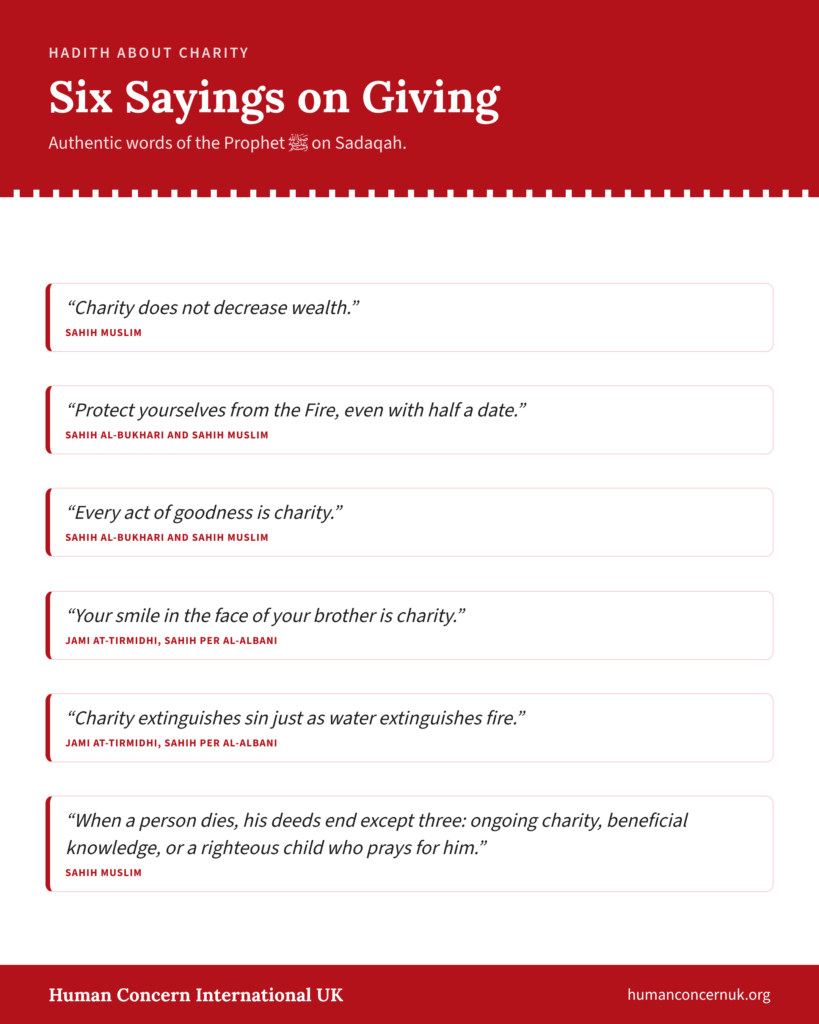
The most famous hadith about charity are that charity does not decrease wealth, that you should protect yourself from the Fire even with half a date, and that every good deed is charity.
| Hadith | Source |
|---|---|
| “Charity does not decrease wealth.” | Sahih Muslim |
| “Protect yourselves from the Fire, even with half a date.” | Sahih al-Bukhari and Sahih Muslim |
| “Every act of goodness is charity.” | Sahih al-Bukhari and Sahih Muslim |
| “When a person dies, his deeds come to an end except for three.” | Sahih Muslim |
| “The upper hand is better than the lower hand.” | Sahih al-Bukhari and Sahih Muslim |
No. The Prophet ﷺ said: “Charity does not decrease wealth, and Allah increases a servant in honour when he forgives, and no one humbles himself for the sake of Allah except that Allah raises him.” (Sahih Muslim)
This hadith answers the fear that stops many people from giving. The money leaves your account, but Allah places barakah in what remains and replaces it in ways you may not see.
A second hadith confirms the promise. The Prophet ﷺ said that every morning two angels come down. One says, “O Allah, give the one who spends a replacement,” and the other says, “O Allah, give the one who withholds destruction.” (Sahih al-Bukhari and Sahih Muslim)
In a hadith qudsi, Allah says: “Spend, O son of Adam, and I will spend on you.” (Sahih al-Bukhari and Sahih Muslim). For more on how giving brings blessing into a life, read the profound impact of voluntary Sadaqah in Islam.
Yes. The hadith make clear that no act of charity is too small, and that charity is not only money.
1. Half a date. “Protect yourselves from the Fire, even with half a date.” (Sahih al-Bukhari and Sahih Muslim)
2. Every good deed. “Every act of goodness is charity.” (Sahih al-Bukhari and Sahih Muslim)
3. A smile. “Your smile in the face of your brother is charity.” (Jami at-Tirmidhi, graded sahih by al-Albani)
4. Charity for every joint. The Prophet ﷺ said charity is due on every joint of the body each day the sun rises. Judging fairly between two people is charity, helping a man onto his mount is charity, a good word is charity, every step towards prayer is charity, and removing something harmful from the road is charity. (Sahih al-Bukhari and Sahih Muslim)
5. Planting a tree. “No Muslim plants a tree or sows a crop, and then a bird, a person or an animal eats from it, except that it is charity for him.” (Sahih al-Bukhari and Sahih Muslim)
6. Water for any living being. The Prophet ﷺ told of a man who gave water to a thirsty dog, and Allah forgave him. The companions asked if there is reward in caring for animals. He said: “In every living being there is reward.” (Sahih al-Bukhari)
These hadith open the door of charity to everyone, including children, students and people with little to spare. Our guide to what Sadaqah is explains the many forms it takes.
The best charity is given while you are healthy and still value your wealth, it is given in secret, and it continues to benefit people after you are gone.
7. Giving while you still want your wealth. A man asked which charity has the greatest reward. The Prophet ﷺ said: “That you give charity while you are healthy and greedy, fearing poverty and hoping for wealth. Do not delay until your soul reaches your throat.” (Sahih al-Bukhari and Sahih Muslim)
8. Secret charity. Among the seven people Allah will shade on the Day when there is no shade but His is “a man who gives charity and hides it, so that his left hand does not know what his right hand gives.” (Sahih al-Bukhari and Sahih Muslim)
9. Charity that continues. “When a person dies, his deeds come to an end except for three: ongoing charity, knowledge that benefits others, or a righteous child who prays for him.” (Sahih Muslim). This is the root of Sadaqah Jariyah, explained in what is Sadaqah Jariyah.
10. Water as charity. Sa’d ibn Ubadah (may Allah be pleased with him) asked which charity was best for his late mother. The Prophet ﷺ said: “Water.” Sa’d dug a well and said it was for his mother. (Sunan Abi Dawud, graded hasan by al-Albani). This is why so many families choose a water well, as explained in why water wells come first.
11. Charity to relatives. “Charity given to a poor person is charity, and charity given to a relative is two things: charity and upholding family ties.” (Jami at-Tirmidhi and Sunan an-Nasa’i, graded hasan)
12. Spending on your family. “When a man spends on his family, hoping for reward, it is charity for him.” (Sahih al-Bukhari and Sahih Muslim)
Charity removes sins, raises your rank and becomes your shade on the Day of Judgement.
13. It extinguishes sins. “Charity extinguishes sin just as water extinguishes fire.” (Jami at-Tirmidhi, graded sahih by al-Albani)
14. It becomes your shade. “Every person will be in the shade of his charity until judgement is passed between people.” (Musnad Ahmad, graded sahih by al-Albani)
15. Allah grows it. “Whoever gives charity equal to a date from good earnings, and Allah accepts only what is good, Allah takes it in His right hand and grows it for its owner, as one of you raises a foal, until it becomes like a mountain.” (Sahih al-Bukhari and Sahih Muslim)
16. The giving hand is better. “The upper hand is better than the lower hand. The upper hand is the one that gives and the lower hand is the one that asks.” (Sahih al-Bukhari and Sahih Muslim)
You can give charity on behalf of a parent or loved one who has passed away, and the reward reaches them.
17. Charity for a mother. A man told the Prophet ﷺ that his mother had died suddenly and that he thought she would have given charity if she could speak. He asked if she would be rewarded if he gave on her behalf. The Prophet ﷺ said: “Yes.” (Sahih al-Bukhari and Sahih Muslim). Our guide to Sadaqah Jariyah for the deceased explains how to do this.
The Prophet ﷺ was the most generous of people, and he was most generous in Ramadan.
18. Like the blowing wind. Ibn Abbas (may Allah be pleased with him) said the Prophet ﷺ was the most generous of people, and most generous in Ramadan when Jibreel met him. He was more generous than the free blowing wind. (Sahih al-Bukhari and Sahih Muslim)
19. He never said no. Jabir (may Allah be pleased with him) said the Prophet ﷺ was never asked for something to which he said no. (Sahih al-Bukhari and Sahih Muslim)
20. Feeding others. A man asked which part of Islam is best. The Prophet ﷺ said: “To feed others, and to greet those you know and those you do not know.” (Sahih al-Bukhari and Sahih Muslim)
Human Concern International UK is a registered charity in England and Wales (charity number 1206222), based in Manchester. We share the name and mission of Human Concern International, which has delivered relief and development since 1980. As a Muslim charity in the UK, we provide food, clean water, healthcare, education and orphan support through field teams and trusted local partners who verify need.
Each hadith above is an invitation. Half a date, a cup of water, a meal for a stranger: the Prophet ﷺ showed that no gift is too small when it is given for Allah. Give Sadaqah today and let these words become part of your own story.
Give a little extra