
The only words required for a valid Qurbani are the name of Allah spoken at the moment of slaughter. Saying “Bismillah” makes the sacrifice lawful, and adding “Allahu Akbar” follows the practice of the Prophet ﷺ. Everything else, from the intention you hold in your heart to the dua asking Allah to accept it, is recommended rather than required. Knowing which is which protects your worship and removes the worry that you have said the wrong thing.
If a charity performs your Qurbani for you, the words are said by the person doing the slaughter, not by you. Your part is the intention. This page sets out exactly what to say at each stage, the Sunnah acts that surround the sacrifice, the rules for choosing an animal and the days on which Qurbani is valid.
There is no single long dua that must be memorised. The Sunnah is short. Anas ibn Malik reported that the Prophet ﷺ sacrificed two horned rams, mentioned the name of Allah over them and said “Allahu Akbar” (Sahih al-Bukhari 5565, Sahih Muslim 1966).
| Stage | What to say | Ruling |
|---|---|---|
| Before the slaughter | The intention, held silently in the heart | Required, but not spoken aloud |
| At the moment of slaughter | “In the name of Allah. Allah is the Greatest.” | Bismillah is required, the Takbeer is Sunnah |
| Immediately after | “O Allah, accept this from me.” | Recommended |
Aisha, may Allah be pleased with her, reported that when the Prophet ﷺ sacrificed he said the name of Allah and asked Him to accept it from Muhammad, from the family of Muhammad and from the ummah of Muhammad (Sahih Muslim 1967). That narration is the basis for adding a request for acceptance after the sacrifice, and for making Qurbani on behalf of your household.
No. When you appoint someone to carry out the sacrifice for you, the words at the moment of slaughter are their responsibility. Scholars agree that the appointed person names Allah over the animal and the Qurbani is valid on your behalf.
What remains yours is the intention. Form it clearly when you make the donation: this Qurbani is for me, for the sake of Allah. You can also make your own dua at any point during the days of Eid asking Allah to accept it. There is no need to time it to the moment of slaughter, and you do not need to be told when the animal was sacrificed for your Qurbani to count.
Takbeer al-Tashreeq is the declaration of Allah’s greatness recited after every obligatory prayer through the days of Eid al-Adha. The majority of scholars hold that it begins after Fajr on the 9th of Dhul Hijjah, the Day of Arafah, and continues until after Asr on the 13th.
The wording most commonly used is: “Allah is the Greatest, Allah is the Greatest. There is no god but Allah. Allah is the Greatest, Allah is the Greatest, and to Allah belongs all praise.” This is reported from the Companions rather than as a marfu’ hadith, and the exact wording varies between narrations. Say it aloud after each fard prayer. It is one of the simplest ways to keep the days of Eid connected to worship.
Six practices surround the sacrifice. Each has evidence behind it, and none of them is difficult.
Make the intention. The Prophet ﷺ said that actions are judged by intentions (Sahih al-Bukhari 1, Sahih Muslim 1907). Qurbani costs money and effort, so decide before you pay that this is for Allah alone.
Leave your hair and nails from the 1st of Dhul Hijjah. Umm Salamah, may Allah be pleased with her, reported that the Prophet ﷺ said whoever intends to sacrifice should not remove anything from his hair or nails once the ten days begin (Sahih Muslim 1977). This applies to the person offering the Qurbani, not to the whole family, and it ends once the animal is sacrificed. If you forget and trim something, your Qurbani is still valid.
Choose a sound animal. The Prophet ﷺ named four defects that make an animal unacceptable: obvious blindness in one eye, obvious illness, obvious lameness, and being so thin that there is no marrow in the bones (Sunan Abi Dawud 2802, graded sahih).
Treat the animal well. The Prophet ﷺ instructed that when you slaughter, you do it well, and that the blade should be sharpened and the animal put at ease (Sahih Muslim 1955). Sharpening the knife out of the animal’s sight and not slaughtering one animal in front of another are part of this.
Perform it yourself where the law allows. Doing the sacrifice with your own hands is Sunnah. In the UK this is not possible for most people, because religious slaughter has to take place in an approved slaughterhouse. Appointing someone else is fully valid and was done by the Prophet ﷺ himself, who delegated part of his sacrifice at the farewell Hajj.
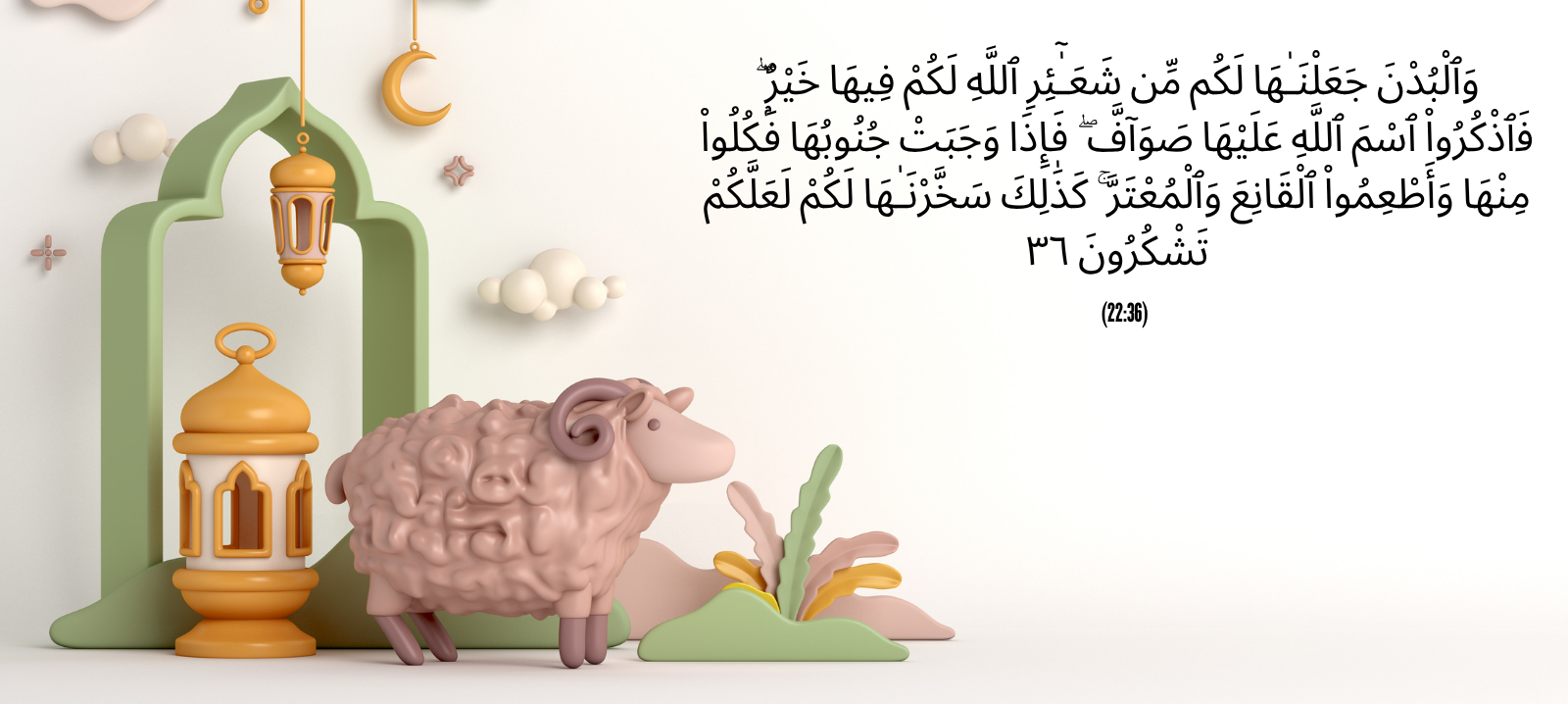
Share the meat. Allah says to eat from it and to feed the needy (Surah Al-Hajj 22:28). The familiar split into three parts, one for your household, one for family and friends and one for the poor, is a recommendation from the scholars rather than a fixed obligation. If you give the whole animal away, your Qurbani is still complete.
An animal must reach a minimum age and be free of the four defects above. Large animals can be shared between seven people, based on the report of Jabir that a camel was offered for seven and a cow for seven (Sahih Muslim 1318).
| Animal | Minimum age | Shares |
|---|---|---|
| Sheep | One year, or a well-grown lamb of six months | One share |
| Goat | One year | One share |
| Cow or buffalo | Two years | Seven shares |
| Camel | Five years | Seven shares |
One sheep or goat covers the person offering it and the members of their household, so a family does not need one animal each.
Qurbani is valid only after the Eid prayer on the 10th of Dhul Hijjah. Al-Bara ibn Azib reported that the Prophet ﷺ said whoever slaughters before the prayer has simply provided meat for his family, and it does not count as a sacrifice (Sahih al-Bukhari 5545, Sahih Muslim 1961).
The end point differs between the schools. The Hanafi, Maliki and Hanbali position is that Qurbani ends at sunset on the 12th of Dhul Hijjah, giving three days. The Shafi’i position extends it to sunset on the 13th, giving four. Follow the position your local scholars hold, and if you are donating through a charity, check which deadline they work to.
For 1448 AH, Dhul Hijjah is expected to begin around 7 May 2027, with the Day of Arafah on 15 May and Eid al-Adha on 16 May. These dates depend on moon sighting and may shift by a day.
Scholars differ. The Hanafi school holds that Qurbani is wajib on every adult Muslim of sound mind who owns wealth above the nisab on the days of Eid. The Maliki, Shafi’i and Hanbali schools hold that it is a confirmed Sunnah, strongly encouraged but not sinful to leave.
Both positions treat it as something a capable Muslim should not skip. If your circumstances are tight this year, there is no sin in the majority view, and no one should take on debt to perform it.
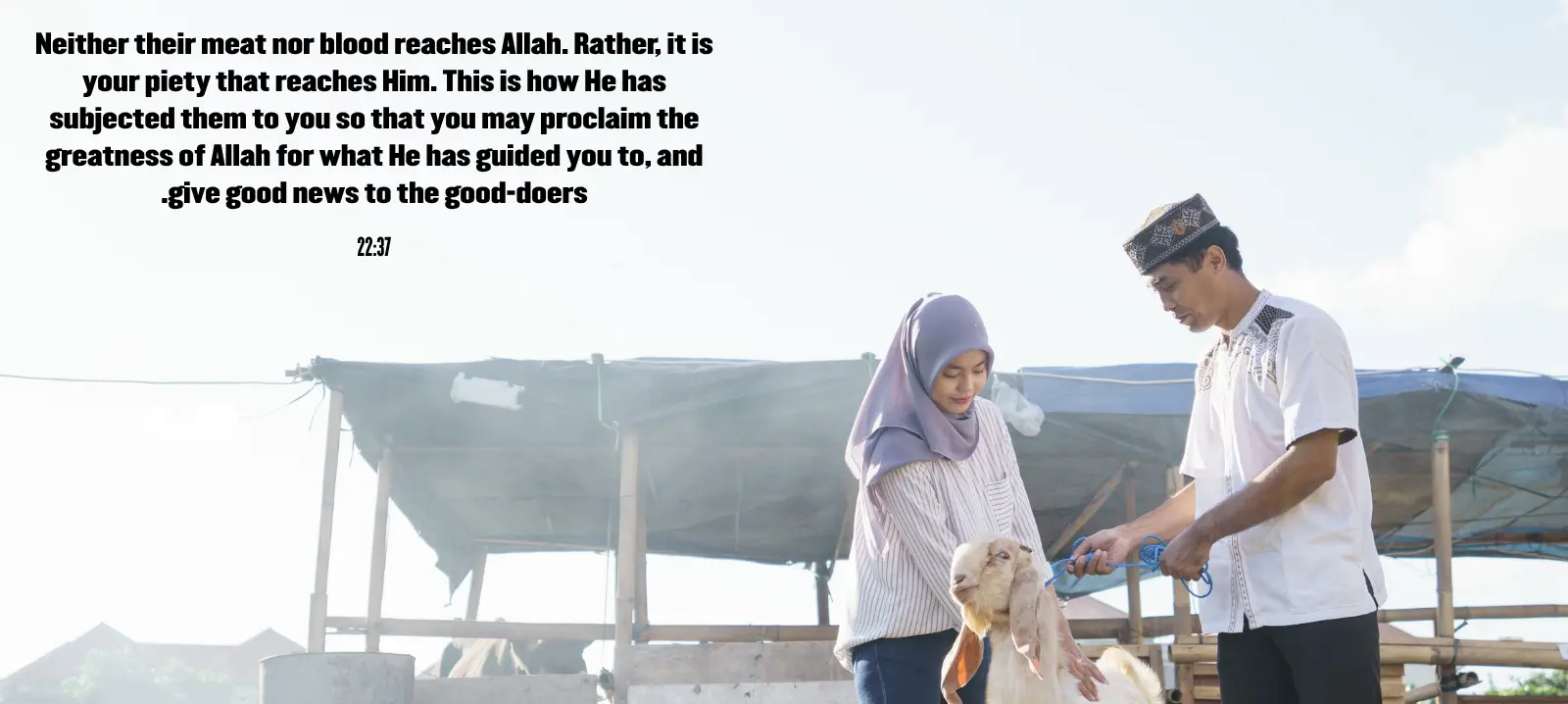
No, if you are able to offer the sacrifice. The act of shedding blood on these specific days is the worship itself, and giving the value in cash does not replace it. Allah says that neither the meat nor the blood reaches Him, but rather the piety of the giver (Surah Al-Hajj 22:37). That verse teaches sincerity in the act, not a licence to substitute it.
If you cannot arrange a sacrifice yourself, appointing a trusted charity to do it for you is the answer rather than converting it to a cash donation. Human Concern UK carries out Qurbani under scholarly supervision and distributes the meat to families for whom it may be the only meat they eat that year.
Yes. The majority of scholars permit it and treat the reward as reaching the deceased. It is separate from your own Qurbani.
Your Qurbani remains valid. The instruction is recommended, not a condition, and forgetfulness is excused.
Yes. A woman with her own wealth may offer her own sacrifice. She is also covered if the head of the household includes her in theirs.
Scholars differ. Some permit one animal for both intentions, while others require a separate animal for each. Ask a scholar you trust before deciding.
No. Once you appoint a charity, the obligation rests with them to carry it out within the valid days
Qurbani is remembered as an act of sacrifice, but the Sunnah around it is mostly about care: care in your intention, care for the animal, and care for who receives the meat. Say Bismillah, or make sure the person acting for you does. Hold the intention clearly. Then let the meat reach a family who will remember that Eid because of it.
May Allah accept every Qurbani offered this year. Ameen.
Give a little extra