
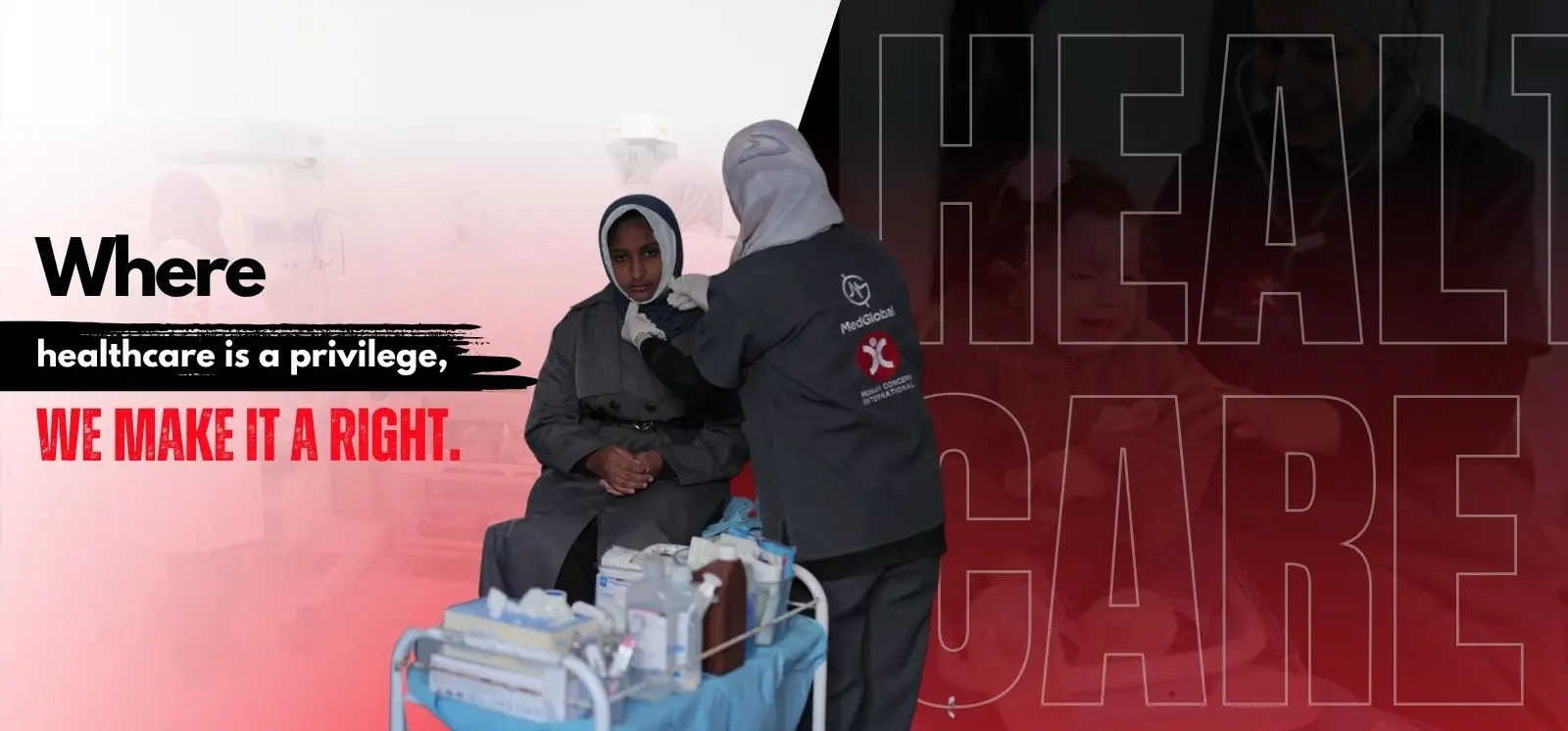
In conflict zones, refugee camps, and communities stretched beyond their limits, the right to healthcare has become a luxury that millions cannot afford. Hospitals destroyed. Clinics overwhelmed. Medicines unavailable. Doctors gone.
For the families HCI serves, getting sick is not just painful; it can be fatal. A child with a fever has nowhere to go. A pregnant woman delivers without medical support. An elderly man with diabetes watches his insulin run out.
This is what HCI’s global health programme exists to change. Not with grand gestures, but with doctors at the bedside, medicines on the shelf, and clinics that stay open when everything else has closed.
Provide one life-saving medical consultation
Provide clean water to five families Provide 1 month of essential medicines
Provide pediatric care for vulnerable children
Provide 1 week of maternal & newborn care
In 2025, HCI delivered targeted health interventions across Gaza, Bosnia, Egypt, Turkey, and beyond, through seven health projects, reaching over 111,000 individuals with essential medical services, psychosocial support, and community health interventions.
These numbers represent real people who had nowhere else to turn. A mother giving birth in a field hospital. A dialysis patient who would have died without the machines HCI procured. An elderly woman in Bosnia whose health was monitored because someone came to her door.
HCI’s approach to health is built on three principles that set us apart from short-term medical missions and one-off interventions. We do not just treat, we build, we train, and we stay.
When conflict or disaster destroys healthcare infrastructure, HCI deploys. We establish medical points, field hospitals, and primary care clinics in areas where local systems have collapsed entirely, providing consultations, surgery, maternal health, chronic disease management, and mental health referrals, all free of charge to patients who could not pay even if services existed.
In Gaza, our Primary Health Care Clinic in southern Gaza has been one of the last lines of defence since January 2024, operating through active conflict, constant resource shortages, and the collapse of the surrounding healthcare system.
A clinic is only as strong as the people who run it. HCI invests in the healthcare workers who will outlast any single project, providing training, clinical education, and the skills to deliver high-quality care in resource-limited settings. When our funding ends, the capacity we built remains.
Some communities do not need emergency relief; they need a functioning health system. HCI establishes and supports medical clinics with a full range of services, from routine check-ups to specialised treatment, procures medicines and diagnostic equipment, and works to strengthen the infrastructure that healthy communities depend on.
The moment a crisis hits, HCI mobilises. We work with trusted local partners and field teams who know these communities, speak the language, and can reach places where many agencies cannot. In Bangladesh right now, our partner teams are conducting house-to-house visits in the Rohingya camps, assessing the most vulnerable families, and preparing for immediate distribution.
Every pound raised goes toward getting aid into the hands of the people who need it most. Here is what we are delivering:
HCI’s health response in Gaza is the most extensive and urgent of all our programmes. Our Primary Health Care Clinic in southern Gaza has delivered 131,731 consultations and medical interventions since January 2024, to displaced families, children, pregnant women, the elderly, and the chronically ill, all free of charge, all in the middle of an active conflict zone.
The clinic provides primary care, chronic disease management, maternal and paediatric health services, minor surgery, mental health referrals, nutrition screening, and essential medicines. In 2025 alone, HCI’s Field Maternity Hospital served 55,797 women, and 11 dialysis units procured by HCI are now operational at three hospitals, sustaining life-saving treatment for patients with renal disease.
Now the clinic’s future is in jeopardy. Without urgent funding, it cannot continue to operate.
In Bosnia, HCI supported 165 elderly individuals through 5,523 home visits, delivering health monitoring, psychosocial support, and essential aid to people who cannot access healthcare on their own. These are individuals who have outlived the war but now face ageing in isolation.
More than 2,227 Gaza evacuees received medical care, housing, financial assistance, and education support through HCI’s programmes in Egypt and Turkey, supporting families who fled the conflict and landed in countries where they have no safety net.
AbdulRahman was only trying to help his mother.
As she struggled to keep up with the endless responsibilities of daily life in crisis, AbdulRahman stepped into the kitchen to help with the cooking. But the fire they were forced to use, because cooking gas is nearly impossible to find in Gaza, was unsafe. In an instant, the flames severely burned his leg, leaving him in immense pain and his family terrified for his future.
Severe burns are not only physically painful. In a place without reliable medical care, they can lead to dangerous infections, long-term complications, and trauma that lasts a lifetime, especially for a child already growing up amid hardship and instability.
But AbdulRahman’s story did not end there.
Through HCI’s partnership with MedGlobal, AbdulRahman received urgent burn treatment and continuous medical care when he needed it most. His wounds were cleaned, treated, and carefully monitored through regular dressing changes and follow-up care, services that most families in Gaza simply cannot access on their own.
What could have become a lifelong tragedy instead became a story of healing, dignity, and hope. Today, AbdulRahman is recovering. His wounds are healing. His family no longer faces this alone.
In a place where even cooking a meal can put a child’s life at risk, HCI’s medical support is doing far more than treating injuries. It is restoring hope to families who have nowhere else to turn.
Every dollar you give goes directly to keeping clinics open, medicines stocked, and doctors at the bedside for people who have no other option.
In Islam, the body is an amanah, a trust from Allah. Caring for it, and for the bodies of those who cannot care for themselves, is not charity in the Western sense. It is an act of worship.
When you fund a clinic in Gaza, you are not donating. You are fulfilling an obligation to the ummah, to the members of your community across the world who are suffering and who have no one else.
The Prophet ﷺ visited the sick. He made du’a for them. He reminded us that in serving those who are unwell, we serve Allah directly.
Your donation is what makes that test survivable. Give now.
Give a little extra