
The four sacred months are the months of the Hijri calendar that Allah made inviolable. They are known as Ash-hur al-Hurum. The word hurum carries two meanings at once: forbidden and sacred. Certain things are forbidden in these months precisely because the months are honoured.
| Sacred month | Position | Meaning of the name | Grouping |
|---|---|---|---|
| Dhul-Qa’dah | 11th month | The month of sitting or resting | First of three in a row |
| Dhul-Hijjah | 12th month | Possessor of the pilgrimage | Second of three in a row |
| Muharram | 1st month | That which is made sacred | Third of three in a row |
| Rajab | 7th month | To honour and magnify | Stands alone |
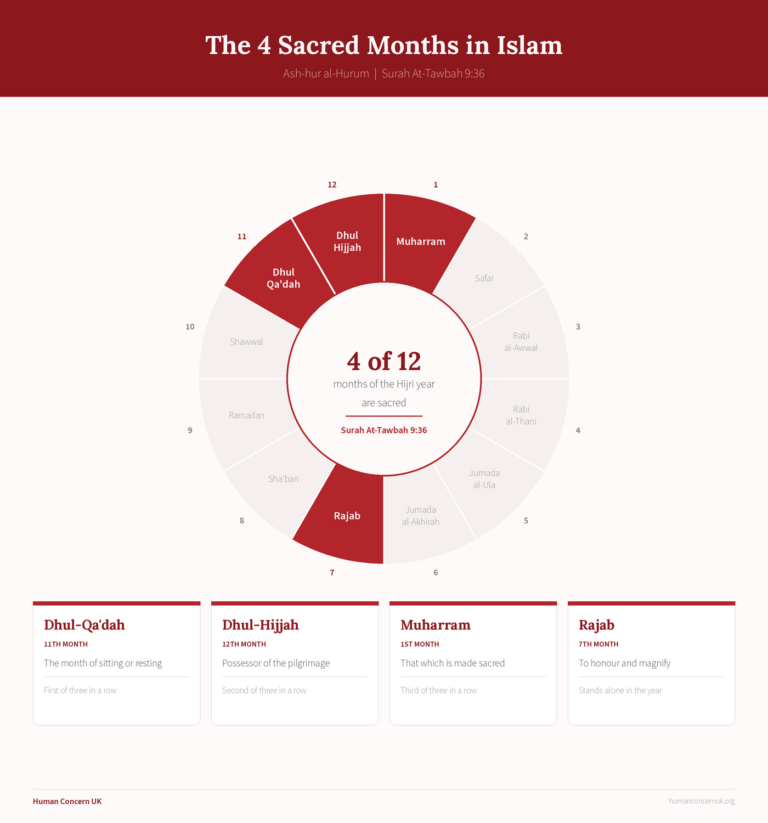
Allah names the sacred months in Surah At-Tawbah. The verse is translated as: “Indeed, the number of months ordained by Allah is twelve, in Allah’s Record, since the day He created the heavens and the earth, of which four are sacred. That is the upright way. So do not wrong yourselves during them.” (Surah At-Tawbah 9:36)
Three points stand out. The count of twelve is tied to creation itself, so no tribe or ruler invented it. Four of those months are singled out. And the command that follows is about justice rather than ritual: do not wrong yourselves. You honour the month by how you treat people in it.
The Prophet ﷺ then named all four. Abu Bakrah reported that he said: “The year is twelve months, four of which are sacred. Three are consecutive: Dhul-Qa’dah, Dhul-Hijjah and Muharram. And Rajab of Mudar, which comes between Jumada and Sha’ban.” (Sahih al-Bukhari 4662, also Sahih Muslim 1679). Rajab is called “Rajab of Mudar” because that tribe kept its sanctity strictly while others tampered with it.
They are sacred because Allah forbade fighting in them and raised the value of what is done in them. Scholars point to clear wisdom behind the timing.
Dhul-Qa’dah, Dhul-Hijjah and Muharram sit around the Hajj. Pilgrims travelled for weeks through tribal land. Dhul-Qa’dah kept the roads to Makkah safe, Dhul-Hijjah covered the rites, and Muharram protected the journey home. Rajab did the same job in the middle of the year for those making Umrah. Beyond safety, the months create four fixed pauses in the calendar. When fighting stopped, disputes cooled, families reconnected and trade resumed.
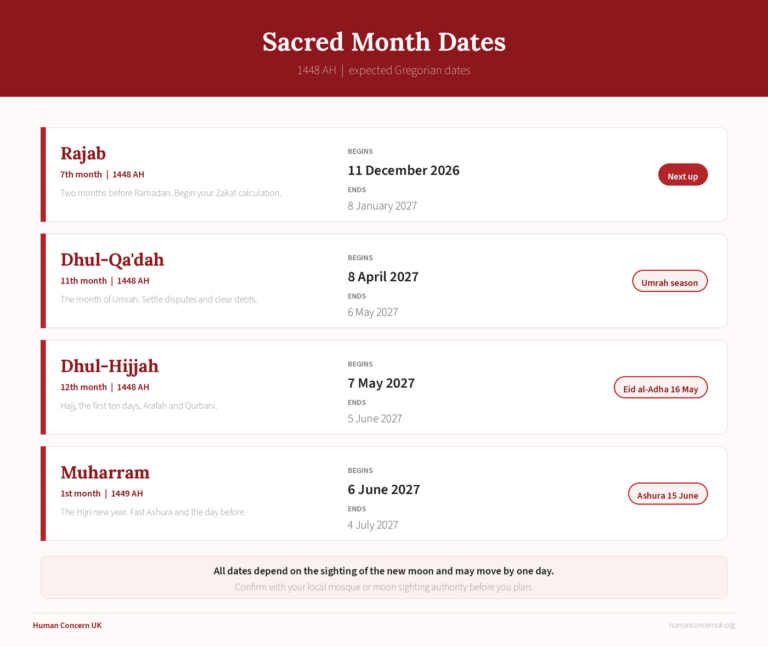
The current Hijri year, 1448 AH, began on 16 June 2026, so Muharram has already passed. The next sacred month is Rajab, expected to begin around 11 December 2026.
| Sacred month | Hijri year | Expected start | Expected end |
|---|---|---|---|
| Rajab | 1448 AH | 11 December 2026 | 8 January 2027 |
| Dhul-Qa’dah | 1448 AH | 8 April 2027 | 6 May 2027 |
| Dhul-Hijjah | 1448 AH | 7 May 2027 | 5 June 2027 |
| Muharram | 1449 AH | 6 June 2027 | 4 July 2027 |
Key days inside them: the Day of Arafah is expected on Saturday 15 May 2027, Eid al-Adha on Sunday 16 May 2027, and Ashura around 15 June 2027. All dates depend on moon sighting and may move by a day. Confirm with your local mosque before you fix any plan.
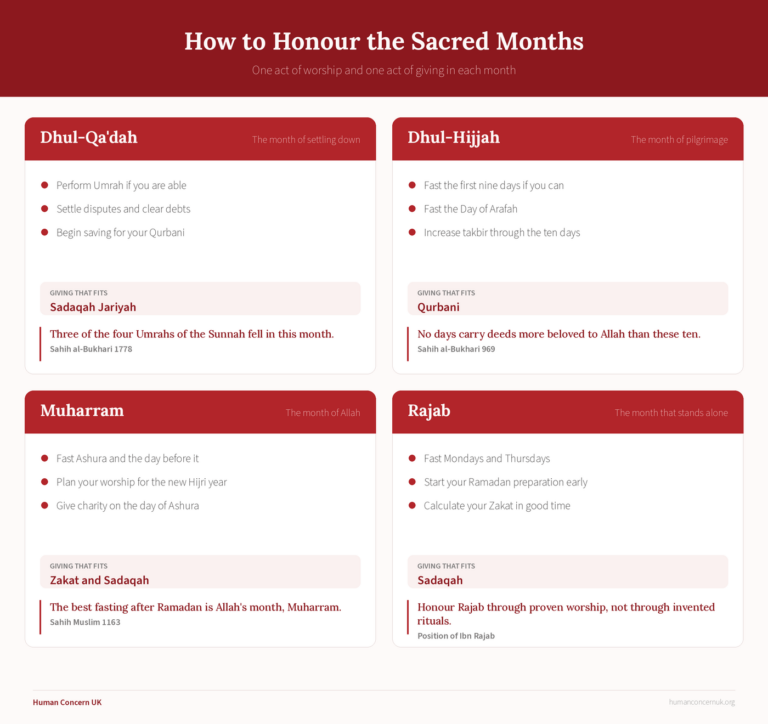
The eleventh month, named for sitting back from fighting as the pilgrimage season opened. Anas ibn Malik reported that the Prophet ﷺ performed four Umrahs, and every one fell in Dhul-Qa’dah except the Umrah joined with his Hajj (Sahih al-Bukhari 1778). The Treaty of Hudaybiyyah was also signed in this month. Perform Umrah if you are able, settle disputes, and begin saving for Qurbani.
The twelfth month holds the densest cluster of blessed days in the year. The Prophet ﷺ said there are no days in which righteous deeds are more beloved to Allah than the first ten days of this month (Sahih al-Bukhari 969). Fasting the Day of Arafah, for those not on Hajj, expiates the sins of the year before and the year after (Sahih Muslim 1162). Then come Eid al-Adha and Qurbani.
The first month of the Hijri year and the only month the Prophet ﷺ attributed directly to Allah. He said: “The best fasting after Ramadan is Allah’s month, Muharram, and the best prayer after the obligatory prayers is the night prayer.” (Sahih Muslim 1163). Fasting Ashura expiates the sins of the previous year (Sahih Muslim 1162), and he intended to fast the ninth day alongside it.
The only sacred month separated from the others. Rajab has real virtue as one of the four, but no specific ritual is tied to a specific night or day of it by an authentic narration. Treat it as the starting line for Ramadan. Increase voluntary fasting and begin calculating your Zakat early.
Yes. The majority of scholars hold that righteous deeds carry greater reward in the sacred months and sins carry greater weight. Ibn Abbas explained that Allah magnified the standing of these four months, so that sin in them is graver and good deeds in them earn more. Qatadah added that wrongdoing is serious in every month, but Allah made it heavier in these.
The multiplier works both ways. A month of extra reward is also a month where a broken family tie or a harsh word costs more. Focus on acts you can sustain for the whole month: voluntary fasting on Mondays and Thursdays, night prayer, a fixed daily portion of Quran, regular charity, sincere repentance and contact with a relative you have lost touch with.
Charity fits these months better than almost any other act, because it keeps working after the month ends. Allah compares the giver to a seed that grows seven ears, each carrying a hundred grains (Surah Al-Baqarah 2:261). The Prophet ﷺ also said that wealth does not decrease through charity (Sahih Muslim 2588).
Human Concern UK runs Zakat, Sadaqah, Sadaqah Jariya, Clean Water and Child Sponsorship programmes throughout the Hijri year, and Zakat funds are kept strictly for those who qualify under the eight categories named in Surah At-Tawbah 9:60.
Several well-known customs, especially around Rajab, have no sound basis. Hadith scholars class the report that “Rajab is the month of Allah, Sha’ban is my month and Ramadan is the month of my ummah” as fabricated. Al-Nawawi and Ibn Taymiyyah both rejected Salat al-Ragha’ib, the special prayer on the first Friday night of Rajab. Scholars including Ibn Rajab noted that no authentic report fixes Isra and Mi’raj to the 27th of Rajab. Aisha stated that the Prophet ﷺ never performed Umrah in Rajab (Sahih al-Bukhari 1776), so Umrah then is permitted but not a special Sunnah. Treating Muharram or Safar as unlucky was rejected outright (Sahih al-Bukhari 5757).
The four sacred months are four openings Allah placed in the year, and each one closes again. Put the dates in your diary. Pick one act of worship you can keep for the whole month, then pick one act of giving, and let that giving carry on working after the month has ended. May Allah allow us to reach these months and accept what we offer in them. Ameen.
Most scholars regard Dhul-Hijjah as the greatest, because it holds the first ten days, Arafah, Hajj and Eid al-Adha. Muharram follows, as the best month for voluntary fasting after Ramadan.
No. Fasting outside Ramadan is voluntary, though strongly encouraged in Muharram and the first nine days of Dhul-Hijjah.
Ramadan is blessed but belongs to a different category. Its distinction is obligatory fasting and the revelation of the Quran. The sacred months are defined by the prohibition of fighting and the greater weight of deeds.
No. Standing at Arafah is a pillar of Hajj and is valid only on the 9th of Dhul-Hijjah. Umrah can be performed at any time.
Rajab 1448 AH, expected around 11 December 2026, subject to moon sighting.
Give a little extra